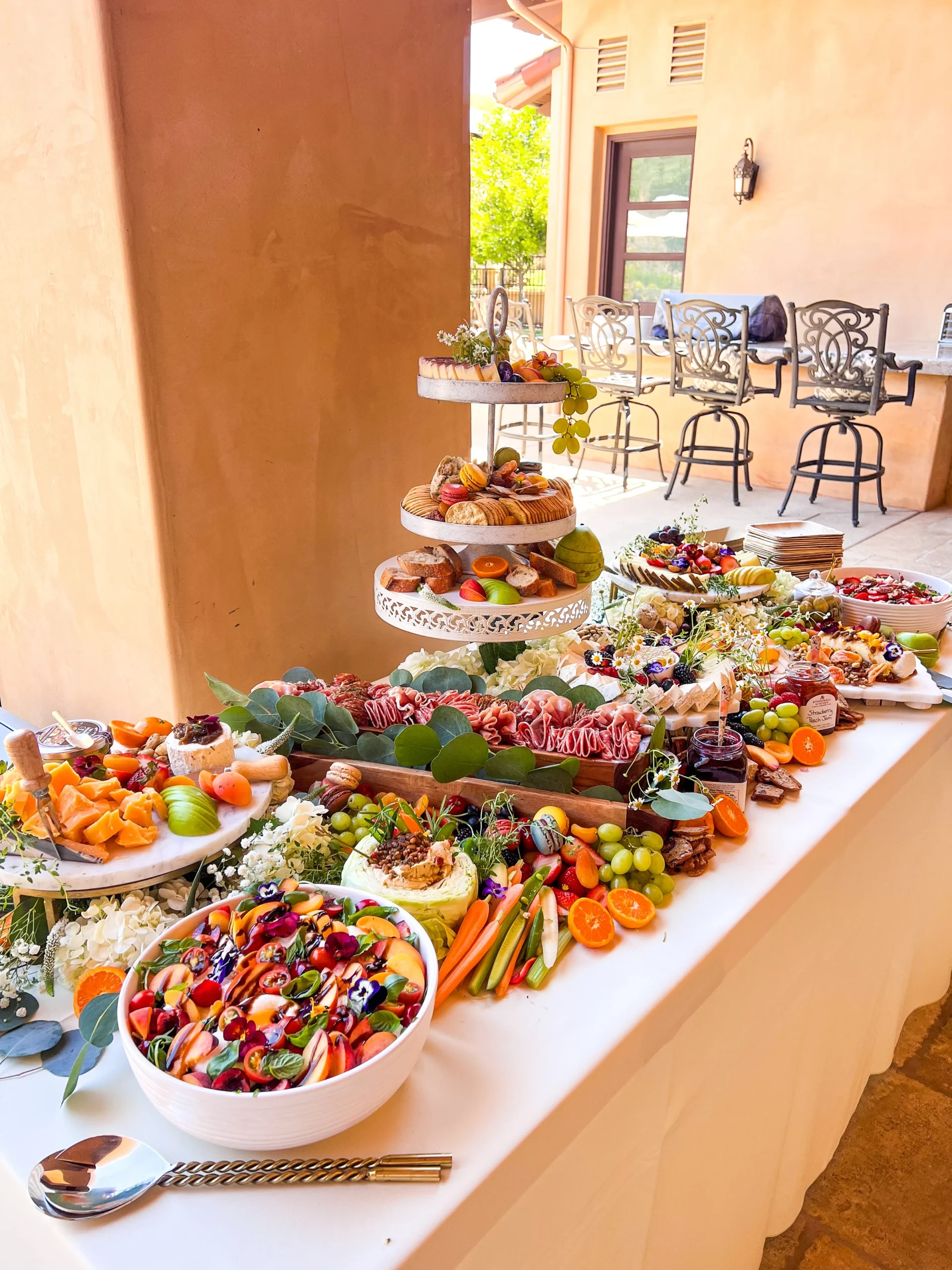
Quick Answer: Grazing table catering is a large-format, styled food display service where cured meats, artisan cheeses, fruits, crackers, dips, sweets, and accompaniments are arranged across a full table surface for guests to serve themselves throughout an event. It replaces traditional buffet or appetizer service with a visually spectacular centerpiece that doubles as entertainment. It works best for weddings, corporate events, baby showers, birthday parties, and celebrations with 20 or more guests.
There is a moment at almost every well-catered event when guests stop circulating and gather around one specific thing. At events with a grazing table, that thing is always the table. It is not just the food that creates the moment. It is the spectacle of abundance, the beauty of an intentionally arranged spread, and the invitation it extends to slow down, stand together, and discover something interesting.
That is what grazing table catering delivers when it is done well. Not just food, but a full sensory experience that creates the social conditions most hosts are trying to engineer. This guide covers what it involves, which event types it serves best, and the practical questions every host in the Phoenix Metro needs answered before booking.
What Does a Grazing Table Actually Include?
The term “grazing table” describes the format, not a fixed menu. The contents vary by provider, event type, and customization, but a well-built table in the charcuterie tradition typically covers five food categories.
Cured Meats and Proteins
Prosciutto di Parma, soppressata, salami varieties, coppa, and mortadella form the savory foundation. These are folded, fanned, and arranged in flowing sections across the table rather than plated in neat rows. The visual difference between folded prosciutto and flat-stacked prosciutto is significant. Professional grazing table catering uses presentation techniques that make the same ingredients look dramatically different from a standard deli platter.
Artisan Cheeses
Three to six cheese varieties depending on table size, covering soft, semi-firm, aged, and bold profiles. On a full grazing table, cheeses are placed as visual anchors at intervals across the length of the table, with accompaniments clustered nearby to encourage pairing. A full brie wheel, a wedge of aged manchego, a crumble of gorgonzola dolce, and a quartered aged gouda together provide enough diversity that every guest finds something that suits their palate.
Fresh and Dried Fruits
Seasonal fresh fruits including grapes, berries, sliced stone fruits, and figs fill color across the table. Dried fruits, Medjool dates, dried apricots, and dried cranberries provide color depth in sections where fresh fruit spacing creates visual gaps. On a properly built grazing table, fruit placement is as intentional as flower placement in a floral arrangement, with warm tones clustered in some sections and cool berry tones in others.
Crackers, Bread, and Vessels
Multiple cracker and bread varieties fill the structural layer of the table. Artisan seeded crackers, water crackers, crostini, sliced baguette rounds, and breadsticks provide the substrate for all the other components. They also add height variation when propped at angles and texture contrast when placed near soft items.
Accompaniments, Sweets, and Garnish
This is where a grazing table distinguishes itself from a standard charcuterie spread. Accompaniments for a full table include small jars of honey and jams, olives and cornichons in ramekins, whole grain mustard, spiced nuts, dark chocolate, macarons or small sweets, fresh herbs and edible flowers used as garnish, and seasonal specialty items that a skilled caterer selects for visual impact and flavor function. The edible flower and fresh herb garnish is not decorative filler; fresh rosemary, thyme, and sage add visual texture and fragrance that elevates the experience.
Which Events Work Best for Grazing Table Catering?
Not every event format is optimized for a grazing table. Understanding where the format excels helps hosts make the right catering decision for their specific situation.
Weddings and Engagement Parties
Grazing tables work particularly well at weddings as cocktail hour centerpieces or ceremony reception spreads. The format encourages mingling, which is exactly what cocktail hours are designed to do. Guests move along the table, make selections, and start conversations with people standing nearby over shared discovery. For weddings in the Phoenix Metro and Chandler area, a styled grazing table also provides a natural photo backdrop that works with nearly every aesthetic.
Baby Showers and Bridal Showers
Shower events typically run two to three hours with guests mingling in a home or event venue. A grazing table provides continuous food access without the awkwardness of a formal seated meal or the blandness of passed appetizers. It also photographs beautifully for the social documentation that shower events reliably produce. A grazing table scaled for 20 to 30 guests at a shower is one of the most commonly ordered formats from Phoenix Metro charcuterie caterers.
Corporate and Office Events
Corporate clients in Chandler and the Phoenix Metro use grazing table catering for client meetings, board presentations, milestone celebrations, office parties, and team appreciation events. The food format communicates thoughtfulness and quality without the formality of a sit-down catered lunch. It also accommodates groups with varied dietary preferences more naturally than plated service, since guests self-select from a diverse spread.
Birthday Parties and Celebration Events
A milestone birthday table built around the guest of honor’s favorite flavors, with customized signage and color-coordinated garnish, creates a food experience that guests remember alongside the celebration itself. Grazing table catering scales from intimate 15-person birthday dinners to large 80-person celebration parties, with table length and component quantity adjusting to guest count.
How to Plan a Grazing Table for a Phoenix Metro Event
The practical planning questions that come up in every client conversation about grazing table catering.
How much space does a grazing table need? A standard six-foot folding table accommodates a grazing spread for 25 to 35 guests. An eight-foot table serves 40 to 60. For larger events, two parallel tables or an L-shaped configuration creates visual impact while allowing access from multiple sides.
How long does it take to set up? Professional grazing table setup for a 30 to 40 person event typically takes one to two hours including layout, arrangement, and styling. Arrival time for the catering team should be factored into venue access and event timeline.
How long does the food last at the table? In Arizona’s climate, indoor events are straightforward. Outdoor summer events require careful timing. Soft cheeses should not sit above 90 degrees Fahrenheit for more than 30 minutes. Professional grazing table caterers in the Phoenix Metro plan table timing around event schedules and outdoor temperature conditions, sometimes staging food in waves for outdoor summer events.
Can the table accommodate dietary restrictions? Most grazing table caterers can accommodate gluten-free, nut-free, or other dietary requirements with advance notice. Because grazing tables are self-service, clear labeling of components helps guests with restrictions navigate independently.
What Separates a Stunning Grazing Table from a Messy Spread
Here is the thing most people miss about grazing tables: they look effortless because they were built by someone who made every decision intentionally. The chaos is controlled.
Visual flow: A professional grazing table has a visual direction, usually following the table length with color and component transitions that lead the eye from one end to the other. There are focal points (cheese anchors, a tall element, a distinctive fruit cluster) and transition zones between them.
Layer and height: Items are propped, stacked, and raised using boards, risers, and folded linens under the tablecloth. The elevation variety creates shadow and dimension that makes the table look three-dimensional in photographs and in person.
Density: The table should look full even after half the food has been consumed. This requires building with the right quantity and replenishing strategically during the event. Sparse grazing tables are a styling failure before they are a quantity failure.
Garnish as structure: Fresh herbs, edible flowers, and lemon slices are not decorative afterthoughts. They fill gaps between food sections, separate flavor zones visually, and add the organic irregularity that makes the table look natural rather than arranged.
Frequently Asked Questions
Q: What is grazing table catering?
Grazing table catering is a large-format food display service where meats, cheeses, fruits, crackers, and accompaniments are styled across a full table for guests to graze from throughout an event. It combines food service with visual display, creating an experience that works as both catering and event decor.
Q: How much does grazing table catering cost in Phoenix Metro?
Pricing varies by table size, guest count, ingredient quality, and customization. In the Phoenix Metro and Chandler area, professionally catered grazing tables typically run from $300 to $800 for small events, with larger wedding or corporate installations ranging higher based on scope. Per-person pricing from specialty providers generally falls between $15 and $35 per guest for appetizer-scaled service.
Q: How many people does a grazing table serve?
A standard six-foot grazing table serves 25 to 40 guests for appetizer or cocktail hour service. An eight-foot table serves 40 to 60. Larger events use multiple table configurations. The answer also depends on whether the table is the sole food source or one station among several.
Q: How far in advance should I book grazing table catering?
For weekend events and peak season (fall and spring in Arizona, when outdoor events are most common), booking four to six weeks in advance is recommended. For weddings and large corporate events, two to three months is safer. Last-minute bookings within one week are sometimes possible for smaller setups when availability permits.
Q: Does the catering team stay for the event?
Policies vary by provider. Some grazing table caterers deliver, set up, and leave. Others provide a team member who stays to replenish the table and manage the spread during the event. For larger events with more than 50 guests, having someone present to maintain the table through the event is worth discussing with your caterer.
