Quick Answer: CNC machining services use computer-controlled machines to cut, mill, and shape raw materials into precise parts. Choosing the right provider directly affects your part quality, lead times, and total production cost. Not every CNC machine shop operates with the same equipment, tolerances, or material expertise, so the selection decision carries real consequences for manufacturers and engineers alike.
Most people assume a part is a part. Hand over the CAD file, get back the component. Simple.
Here’s the thing most people miss: two shops quoting the same job can deliver results that look nothing alike. One ships parts that fit. The other ships parts that fail first-article inspection. The difference rarely comes down to the file you sent. It comes down to the shop you chose.

What CNC Machining Services Actually Cover
CNC machining is defined as a subtractive manufacturing process where computer numerical control systems guide cutting tools to remove material from a workpiece. It covers a broad family of operations: CNC milling, CNC turning, multi-axis machining, drilling, boring, and surface grinding.
What most buyers don’t realize is how much variation exists within that definition. A shop running 3-axis vertical mills handles very different work than one running 5-axis simultaneous machining centers. Tolerances achievable on a 3-axis setup may top out at ±0.005 inches, while advanced 5-axis machines regularly hold ±0.001 inches or better. That gap is enormous if you’re making aerospace brackets or medical implant components.
Good CNC machining services don’t just cut metal. They consult on material selection, flag design-for-manufacturability issues before cutting starts, and maintain process documentation that supports traceability and compliance.
What Separates a Strong CNC Machine Shop from a Mediocre One
Equipment is visible. Process discipline is not. This is where most buyers get burned.
A capable CNC machine shop invests in CMM (Coordinate Measuring Machine) inspection equipment, maintains calibration records, and employs programmers who understand GD&T (Geometric Dimensioning and Tolerancing). Shops that skip this layer often produce parts that measure correct on a caliper but fail assembly because the true position of a feature is off.
Material expertise matters just as much. Machining 6061 aluminum is straightforward. Machining titanium grade 5 (Ti-6Al-4V) or Inconel 718 requires entirely different toolpath strategies, cutting speeds, and coolant approaches. A shop that treats both the same way will struggle with one of them.
Ask any prospective shop these two questions. First: what is your first-article inspection process? Second: what’s your average on-time delivery rate over the last 12 months? Their answers will tell you more than any capability brochure.
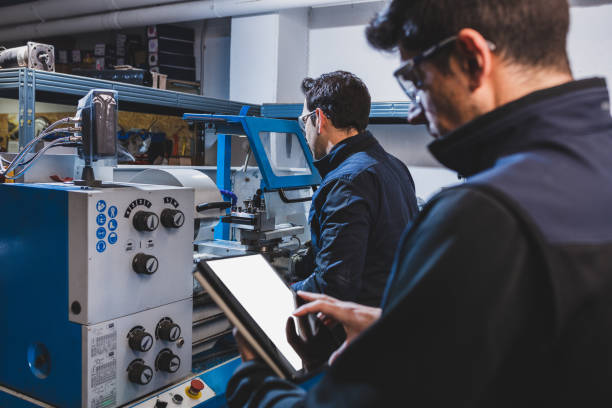
When Precision Machining Gets Complex
Multi-axis machining changed what’s possible. Parts that once required four separate setups, each introducing locational error, can now be completed in a single fixture on a 5-axis machining center. This matters for complex geometries found in aerospace, defense, robotics, and medical device manufacturing.
And this is where it gets interesting. The complexity isn’t in the machine. It’s in the CAM programming (Computer-Aided Manufacturing) that generates the toolpaths. A poorly programmed 5-axis job produces worse results than a well-programmed 3-axis job. The human expertise behind the software is still the limiting factor, even in a field as automated as CNC machining.
Frequently Asked Questions
Q: What materials can CNC machining services work with? A: Most shops machine aluminum alloys, steel, stainless steel, brass, copper, and engineering plastics like Delrin and PEEK. Specialized shops also handle titanium, Inconel, and other high-temperature alloys used in aerospace and medical applications.
Q: How do I know if a CNC machine shop can hold tight tolerances? A: Ask for their inspection capabilities and whether they have CMM equipment on-site. Shops holding tolerances below ±0.002 inches should have documented calibration processes and be able to provide inspection reports with delivered parts.
Q: What’s the difference between CNC milling and CNC turning? A: CNC milling moves a rotating cutting tool across a stationary workpiece to remove material. CNC turning rotates the workpiece against a stationary cutting tool, typically used for cylindrical parts like shafts and bushings.
Q: How long does a typical CNC machining job take? A: Lead times vary from 3 to 15 business days depending on part complexity, material availability, and shop workload. Simple prototype runs often ship faster; production runs with tight tolerances require more setup and inspection time.
Q: Is CNC machining better than 3D printing for functional parts? A: For most structural, load-bearing, or high-tolerance applications, CNC machining produces superior mechanical properties because it works from solid stock material rather than building up layers. 3D printing suits complex geometries and prototyping where tolerances are less critical.
